Start Here: Spend Time on Decisions, Not Back-and-Forth Scheduling
Every day a role stays open, a hiring manager does two jobs. Every week first-round screening slips, a strong candidate may accept another offer. Many companies already “have HR” and still stall on three repetitive loops: reading resumes by hand, chasing schedules, and running live first-round interviews.
This white paper helps HR make three points internally:
- Why a dedicated recruiting team can still bottleneck on screening and first rounds
- Which repetitive work the platform automates—and which judgments stay human
- How to persuade leadership with per-candidate and per-role math, plus a 30-day pilot
1. Why Dedicated Recruiting Still Gets Stuck
“Having HR” clarifies accountability: who opens requisitions, who aligns managers, who negotiates offers, and who owns compliance. It does not automatically solve capacity and evidence. When volume rises, the constraint is usually not “whether we know how to recruit,” but screening, scheduling, and first-round repetition.
- 1 · HR time is capped: even strong recruiters have only so many hours; quality and speed start to trade off as volume rises.
- 2 · Managers are costlier and harder to book: if every round requires a live seat, hiring pace follows their calendar.
- 3 · Standards drift and are hard to reconstruct: different people read resumes and ask questions differently; handoffs get expensive.
- 4 · Amplify capacity, do not replace people: AI completes the early round and leaves reports and video; HR judges, managers review priority candidates.
In short: headcount without scalable early-stage operating capacity becomes a linear cost problem, not a structural fix.
2. At a Glance: HR Alone vs. HR Plus a Platform
| Dimension | HR / existing process only | HR + AI hiring platform |
|---|---|---|
| Resume screening | Manual review; quality drifts as volume rises | Role-based ranking and summaries; HR reviews exceptions |
| Scheduling / first round | Live calendars stall on three parties | Asynchronous video interviews candidates can complete within 24 hours |
| Manager collaboration | Scattered notes, forms, and chasing | Structured reports and playback for fast decisions |
| Standards and traceability | Standards in people’s heads; rationale rebuilt from email | Shared prompts and scores; review checkpoints remain auditable |
| HR’s role | Becomes a screening and scheduling center | Returns to role definition, exceptions, candidates, and offers |
3. Where Time Is Saved: Per Person and Per Role First
Leadership usually understands unit savings before monthly totals. Illustrative model (replace with your numbers later): 100 resumes/month → 40 scheduled / first-round candidates.
Three intuitive units
| Unit | Illustrative savings | How to read it |
|---|---|---|
| Per first-round candidate | ~50 minutes | Scheduling ~−18 min + first-round review ~−33 min vs. live booking and sitting through screens |
| Per resume | ~8 minutes | Manual ~10 min → AI-assisted ~2 min (HR focuses on exceptions) |
| Per mid-volume role | ~24 hours | ~50 resumes and 20 first-round candidates (about half the monthly model) |
By work type: before → after
| Work | Before | After | Saved |
|---|---|---|---|
| Resume screening | ~17 hours | ~3 hours | −14 hours |
| Scheduling | ~13 hours | ~1 hour | −12 hours |
| First-round interviews | ~27 hours | ~5 hours | −22 hours |
| Total | ~57 hours | ~9 hours | −48 hours/month (~6 working days) |
“First round after adoption” mainly means reviewing AI reports and video for priority candidates—not rebooking 40 live screens. With about four active roles, spreading −48 hours implies roughly ~12 hours per role (excluding the business impact of open vacancies).
4. What the Platform Does—and Does Not Do
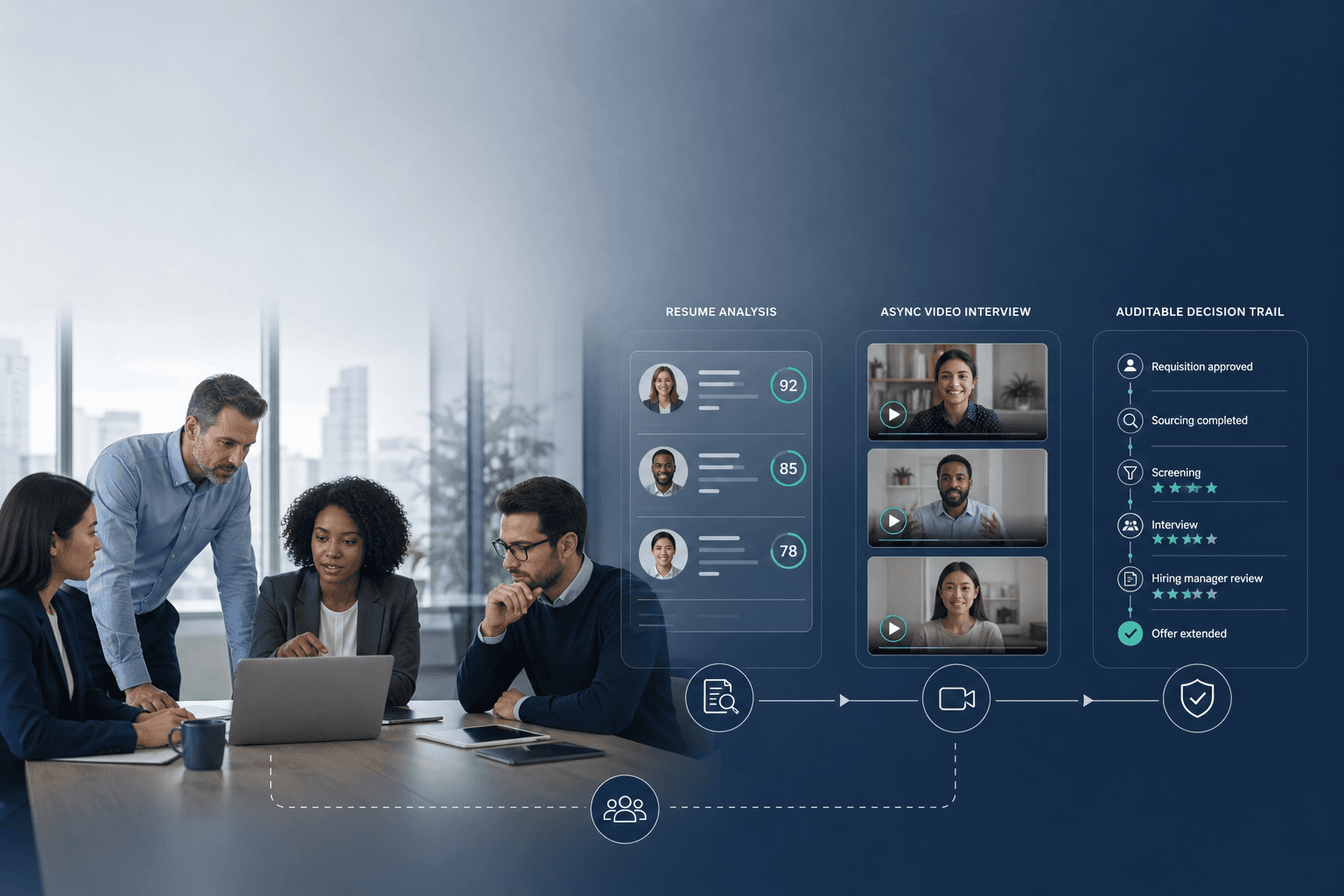
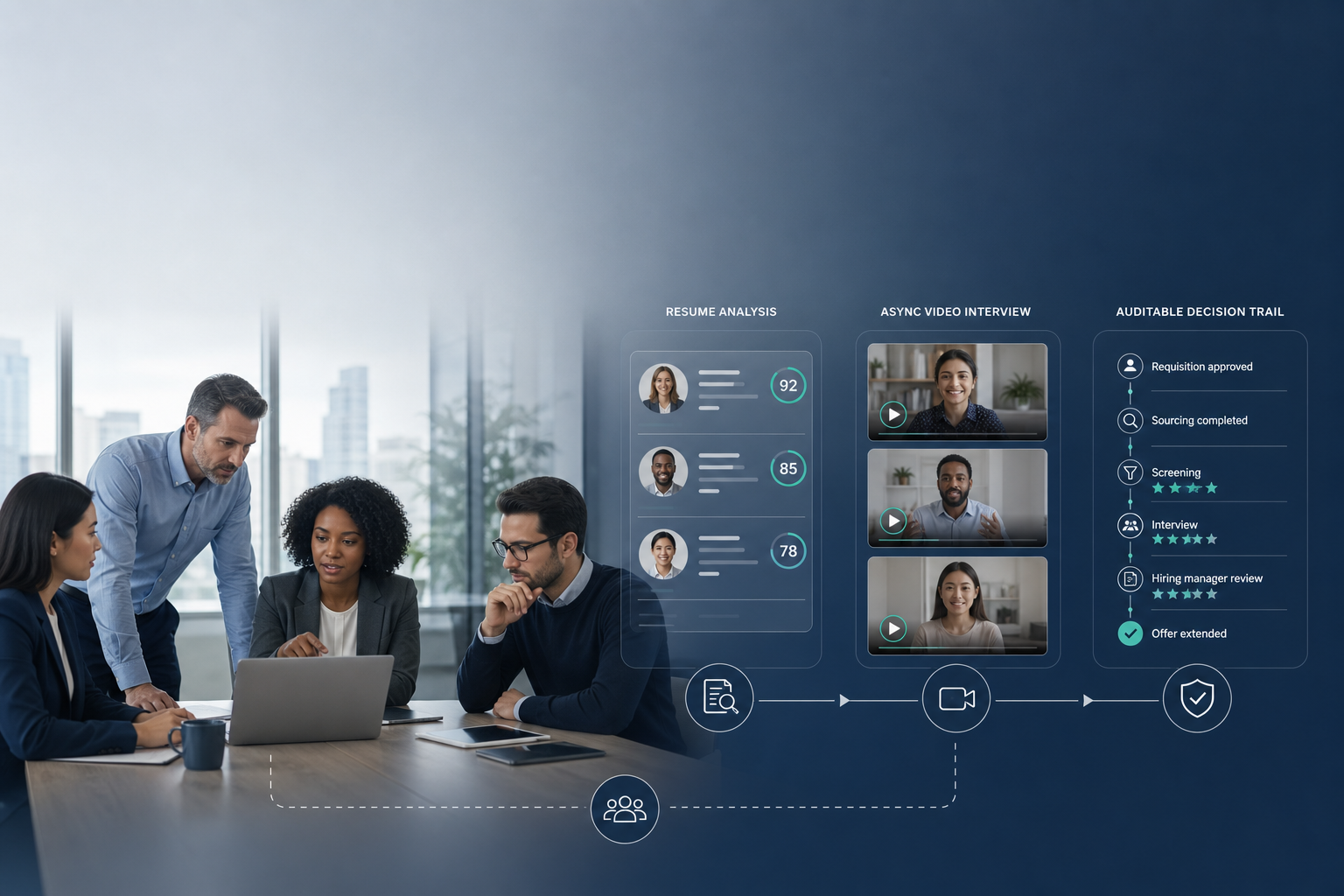
With MIND Interview as an example, the point is not “another chatbot.” It helps HR automate repetitive screening, scheduling, and first-round work, and package evidence for internal proposals and manager review:
- AI resume analysis: rank and summarize against role criteria.
- 24/7 asynchronous video interviews: candidates respond without three-way calendars.
- Structured reports + playback: HR and managers decide from the same pack.
- Auditable trails: prompts, scoring rationale, and review checkpoints remain traceable.
Clear boundaries make approval easier:
- No automated hiring—scores assist; they are not offer letters.
- No replacement for candidate relationships or offer experience.
- No substitute for deep interviews on senior or highly sensitive roles.
- Not another resume database: an ATS answers “where is the candidate?”; this platform answers “why advance them?”
5. How HR Persuades the Boss
Pitch order: operating loss and unit savings → solution and controllability → product name last. Speak the language leadership already uses: time, time-to-fill, risk, and control.
Opening line
“We are not asking to hire more people for first rounds. We want to automate screening and the first round while HR and managers keep final decisions. Roughly ~50 minutes per first-round candidate and ~24 hours per mid-volume role; at about 100 resumes / 40 first rounds a month, early-stage work can return ~48 hours—faster fills, more consistent standards.”
Four angles
- Capacity: you are not doing less work; you are removing repetitive labor so the same team can handle more roles.
- Vacancy cost: every extra open day burdens the business; faster screening shortens time-to-start.
- Risk: shared prompts, scores, and replayable evidence reduce “missed judgment / inconsistent bar” disputes.
- Control: start with one or two roles; humans decide, AI organizes information—not a black box replacing HR.
Common objections → replies
| Leadership asks | HR replies |
|---|---|
| Don’t we already have HR? | Headcount ≠ scalable early rounds. The bottleneck is screening, scheduling, and first-round repetition. |
| Is it worth it? | Estimate with ~50 minutes/person and ~24 hours/role using our volumes; ask for a pilot first. |
| Who owns AI risk? | AI packages early evidence; hire decisions stay human and traceable. |
| Will managers use it? | Managers lack time. Give a minutes-long report plus video—not another heavy login. |
| Why isn’t ATS / job boards enough? | They manage volume and status. We add the evidence layer for “why advance this person.” |
Three moves that raise approval odds
- Pick one painful role family first—do not propose a company-wide swap.
- Bring one hiring manager as co-sponsor.
- Position HR as the team that returns time to judgment and makes decisions defensible—not as a team being replaced.
6. 30-Day Pilot: Prove, Then Scale
Prepare monthly resume volume, first-round volume, and current time-to-fill. Pilot one or two roles:
- Define the success profile and must-assess competencies
- Set resume thresholds and asynchronous interview prompts
- Have managers decide shortlists from the same report format
- Track screening hours, minutes per first-round candidate, manager feedback cycle time, completion rate, and advance rate to live interviews
- Refresh per-person and per-role numbers from the pilot before expanding
Success is not “the system went live.” Success is “first-round conversations became higher value, weak scheduling loops declined, and decisions became easier to explain.”
Conclusion
Having HR signals that the organization takes talent seriously. When application volume rises, seriousness also requires scalable early-stage capacity. MIND Interview is designed so recruiting teams spend time on decisions—not back-and-forth scheduling—identifying candidates worth deeper investment before the live interview, with evidence that can withstand scrutiny.
The next step is not a debate about trusting AI. Choose one real requisition and compare before/after in units every stakeholder understands: per candidate and per role. That is usually the strongest way to persuade leadership.
Time figures are illustrative estimates; actual savings vary by role type and application volume.
Frequently Asked Questions
Key questions often raised by business leaders and HR teams:
If we already have a full HR team, why do we need an AI hiring platform?
HR owns strategy, employer brand, candidate relationships, manager alignment, and final hiring decisions. The platform automates repetitive screening, scheduling, and first-round work, and packages evidence for review. They complement each other; one does not replace the other.
How much time can we save after adoption?
In an illustrative model (100 resumes/month and 40 first-round candidates): about ~50 minutes per first-round candidate, ~24 hours per mid-volume role, and ~48 hours per month on early-stage work (about six working days). Actual results vary by role and volume.
Does this replace HR or hiring-manager judgment?
No. AI completes the early round and leaves reports and video; HR makes key judgments and managers review priority candidates. Hire decisions stay human.
We already use job boards and an ATS. What is still missing?
Job boards create volume and an ATS tracks status. Many teams still lack comparable pre-interview evidence and a manager-ready review pack. The gap is screening quality and decision speed.
How should HR pitch this to the CEO?
Lead with per-person and per-role savings and vacancy cost, then propose a 30-day pilot. Use capacity, time-to-fill, risk, and controllability—do not open with a feature list.